

Here at Format NDT Ltd, we use a huge range of technologies and techniques to provide the best service possible to our clients, but it wasn’t always done this way. These technologies are recent additions in the industry as non-destructive testing has evolved massively in recent years. We have created this blog so that you can see how our amazing industry is changing all the time. If you have a few minutes to spare, we are confident that you will learn something new here.
So What Is Non-Destructive Testing?
Non-destructive testing (NDT) refers to a range of techniques and methods used to evaluate the integrity, quality, and performance of materials, components, and structures without causing any permanent damage or altering their usefulness. It is a crucial process employed in various industries, including manufacturing, construction, aerospace, automotive, and energy.
The primary objective of non-destructive testing is to detect defects, flaws, or irregularities that may compromise the safety, reliability, or functionality of the inspected objects. By employing NDT methods, engineers and technicians can assess the structural integrity, measure physical properties, identify hidden defects, and evaluate the overall condition of materials and structures.
There are several common techniques used in non-destructive testing. One widely used method is visual inspection, which involves a direct examination of the object using the human eye or various optical instruments. Visual inspection allows for the detection of surface defects, such as cracks, corrosion, or improper assembly, but it may not reveal internal flaws.
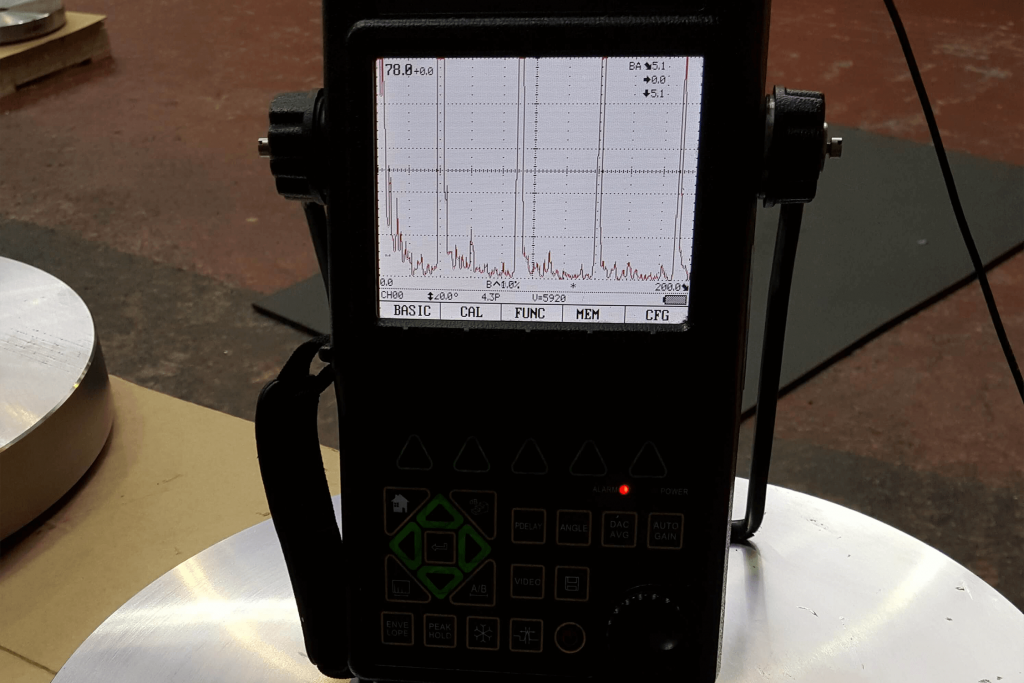
Another common NDT technique is ultrasonic testing (UT), which utilises high-frequency sound waves to inspect the internal structure of materials. By transmitting sound waves into the object and analysing the reflections, technicians can identify defects like cracks, voids, or delaminations. Ultrasonic testing is particularly useful for assessing the thickness of materials, detecting flaws in welds, and evaluating the condition of pipes and tanks.
Magnetic particle testing (MT) is another valuable NDT method. It involves magnetising the object under inspection and applying iron particles or magnetic dyes. If there is a defect or flaw present, the particles will accumulate around the magnetic field discontinuities, indicating the presence and location of the defect. Magnetic particle testing is frequently used for detecting surface and near-surface defects in ferromagnetic materials.
Liquid penetrant testing (PT) is a technique employed to detect surface defects in non-porous materials. It involves applying a liquid penetrant that seeps into the surface discontinuities, such as cracks or pores. After a specified dwell time, excess penetrant is removed, and a developer is applied to draw out the penetrant from the defects, making them visible. This method is commonly used for inspecting materials like metals, ceramics, and plastics.
Radiographic testing (RT) employs X-rays or gamma rays to inspect the internal structure of objects. The radiation passes through the material, and a radiographic film or a digital detector captures the image, revealing any internal defects or irregularities. Radiographic testing is widely used for inspecting welds, castings, and other critical components in industries such as aerospace and oil and gas.
Other non-destructive testing techniques include eddy current testing (ET), which is used for inspecting conductive materials and detecting surface and near-surface defects, and thermography, which utilises infrared cameras to detect variations in temperature and identify heat anomalies associated with defects.
In conclusion, non-destructive testing plays a vital role in ensuring the safety, reliability, and quality of materials, components, and structures across various industries. By utilising techniques such as visual inspection, ultrasonic testing, magnetic particle testing, liquid penetrant testing, radiographic testing, and others, engineers and technicians can identify defects and flaws without causing permanent damage. NDT methods enable proactive maintenance, quality control, and the early detection of potential failures, contributing to enhanced safety standards and improved efficiency in industrial operations.
Where Did It All Start?
The origins of NDT can be traced back to the early 20th century, when it was first used in the aerospace and manufacturing industries to inspect the integrity of structures and equipment. One of the earliest forms of NDT was visual inspection, which involved using the human eye to examine materials and components for defects or damage. This method was used in various industries, including shipbuilding, construction, and manufacturing but was highly inaccurate and offered no insight as to the quality of the material underneath the surface.
Another early form of NDT was the use of X-rays to inspect the interior of materials and components. This method was first used in the medical field, but soon found application in the aerospace and manufacturing industries. In the 1920s and 1930s, advances in technology led to the development of more advanced non-destructive testing methods, such as ultrasonic testing and radiographic testing. These methods allowed for the detection of even the smallest flaws and defects, and they quickly became widely used in various industries.
Since then, NDT has continued to evolve and improve, with the development of new technologies, techniques, and equipment. Today, NDT is widely used in various industries, including aerospace, oil and gas, and construction, to ensure the safety and integrity of structures and equipment.


Advancements in Technology
One of the most significant ways NDT has evolved in recent years is through advancements in technology. The development of more advanced sensors and imaging equipment has allowed for the detection of even the smallest flaws and defects. For example, ultrasonic testing, a common NDT method, now utilises phased array technology, which allows for improved resolution and faster testing times. Additionally, the use of artificial intelligence and machine learning in NDT has increased the accuracy and efficiency of the testing process.
These advancements are far from finished; this industry is still evolving faster and faster every year with new equipment and techniques being utilised. Here at Format NDT in Liverpool, we are constantly learning new things and working to stay ahead of the competition and we expect these advancements to continue into the foreseeable future.
New Inspection Techniques Have Become Available
Another way NDT has evolved in recent years is through the development of new inspection techniques. For example, the use of drones for NDT inspections has become increasingly popular in recent years, allowing for the examination of hard-to-reach or dangerous areas, such as offshore oil platforms or bridges. Additionally, the use of robotics in NDT inspections has also grown, allowing for automated and more efficient testing of large structures and equipment.
Standardisation
The evolution of NDT has also been supported by the standardisation of inspection procedures, which has improved the reliability and consistency of the testing process. Organisations such as the American Society for Nondestructive Testing and the British Institute of Non-Destructive Testing have established guidelines and standards for NDT inspections, which have been adopted by many industries.

Contact Our Team To Utilise These New Technologies
Non-destructive testing is an essential tool in ensuring the safety and integrity of various structures and equipment. In recent years, NDT has evolved through advancements in technology, new inspection techniques, and standardisation of the testing process. These improvements have made NDT more reliable, accurate and efficient, ensuring that the integrity of structures and equipment can be maintained with minimal disruption and cost.
If you need NDT services in the Liverpool and Merseyside area, our team would love to be your first choice. We use these modern advancements to get you the highest quality service time after time and with a wide range of services you will be able to find exactly what you need. Give us a call today!